User Interview - Vol.4
Tetsuya Hatada, CEO of OFFICE TEC Co., Ltd.
This series is an interview project that brings you the real voices of creators and business owners who use drone cameras.
In the fourth installment, we interviewed Tetsuya Hatada, CEO of OFFICE TEC Co., Ltd., an agricultural producer who also runs a wide range of businesses related to the use of drones in agriculture, from schools to sales and maintenance of drones used for pesticide spraying. We asked him about the background to his use of drones, their benefits, the equipment he uses, and more.
■First, please give us a brief introduction about yourself.
Hello, my name is Tetsuya Hatada.
Currently, as a farmer, he cultivates an area of approximately 200 hectares in Hokkaido.
The crops they grow include rice, buckwheat, wheat, soybeans, and more.
I run a company called OFFICE TEC Co., Ltd., which mainly undertakes work on a contract basis, and when the company was selected for the Manufacturing Subsidy (※1), I entered the drone business.
As a farmer, I had been flying helicopters such as the Subaru RPH-2 and the Yamaha FAZER. The FAZER in particular was a complete aircraft, so I didn't think I needed a drone, but after buying one, I was amazed at what it could do, and my thoughts changed.
Since then, we have entered the drone business, teaching as an instructor at a drone school for spraying pesticides, providing repairs and maintenance, selling drones, and also providing services.
For example, the service would involve lending our drone to a farmer who has crashed their drone. If a farmer had planned to fly their drone that day but it crashed and became unusable, it would disrupt their plans and cause a lot of trouble.
When customers tell me that it was a big help, I feel glad that I am doing this.
...I became interested in all kinds of drone-related agricultural businesses and thought it would be ideal if I could handle everything myself, and that has become a reality, and here we are today (laughs).
*1: "Subsidy for Promoting Productivity Improvement in Manufacturing, Commerce, and Services." A subsidy to support capital investment for development and improvement to improve productivity for small and medium-sized enterprises and small businesses.
■Please tell us what made you start using drones.
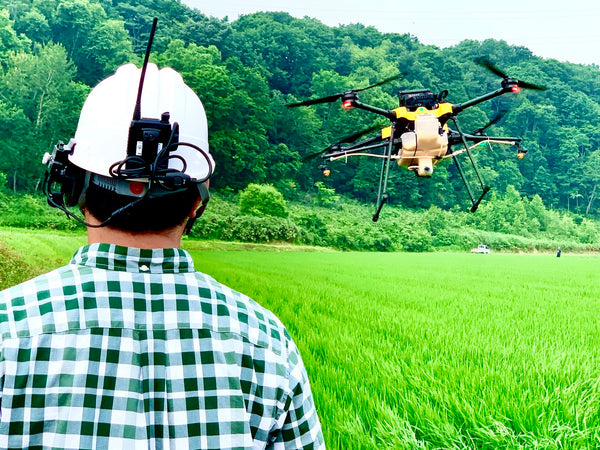
As I mentioned briefly above, it all started when I tried using the Agras MG-1 (*2) for spraying pesticides. I started using it because I thought it would be great if I could spray pesticides that cannot be sprayed by helicopter using a drone.
When I actually used it, I was impressed by how stable it was compared to a helicopter and how it didn't damage the crops.
The main reason helicopters damage crops is because of excessively strong downwash. (*3) Of course, the strength of the downwash has its advantages, but it also means that the rice plants are inevitably buffeted by the wind and damaged.
Drones, on the other hand, have eight blades, so the downwash is just enough to not damage the rice plants. They don't knock them down. On the other hand, some people ask me, "Isn't there so little downwash that the pesticide doesn't reach the roots?" However, I've been using drones for three or four years and they are just as effective as helicopters, so I don't think there's a problem in that regard.
*2...Agricultural drone from DJI, China's largest drone manufacturer.
*3...This refers to the wind blowing down when a helicopter or drone flies. Airflow is generally generated vertically around the aircraft.
What kind of work do you use drones for?
It's mostly pesticide spraying in agriculture.
Apart from spraying pesticides, we also use agricultural drones for a variety of agricultural tasks. As I mentioned earlier, I am also involved in training drone users as an instructor at a drone school.
Now that it is possible to apply for subsidies for equipment that can be used for remote sensing (*4), I am thinking about trying out sensing myself from next year. Right now, I am actively participating in seminars and other events in preparation for this.
Recently, I've been taking pictures of rice harvesting and buckwheat harvesters, hoping that they will help promote the area. I'm still a complete novice when it comes to aerial photography, so it's just for fun (laughs).
What made me want to become a drone school instructor was the MG-1 course I took. The instructor at the time was a farmer, and I thought if farmers could become instructors, I wanted to be one too, so I obtained an instructor qualification.
When I was working with helicopters, I witnessed other operators performing dangerous maneuvers, so one of the reasons I became an instructor was that I wanted to help eliminate such things as much as possible.
That's why we give special emphasis to safety.
Textbooks only cover the basics, such as operation techniques and machine inspections, but we also provide lectures on the basics of spraying, which you can only learn through experience. Otherwise, it would be a disaster if you actually tried to fly it and had an accident.
In that sense, I think it's best to have experienced people as teachers, and I think I can put the experience I've gained to good use in my lessons.
Thanks to you, we have produced 26 students so far. I try to go and see the students' first spraying as much as possible. I'm looking forward to it, but I'm more nervous than excited (wry smile).
*4...A technology that uses images taken by drones to understand the growth status of crops and the health of fields, and then analyzes the data.
■How has the use of drones improved those operations?
The cost performance has improved dramatically.
First of all, the initial cost of a helicopter is 15 to 16 million yen, but a drone can be purchased for around 3 to 4 million yen. Annual maintenance and insurance costs are also about one-third of the price. In that case, I think it would definitely be better to buy two drones than one helicopter.
Helicopters are certainly more efficient in areas where spraying is concentrated, but drones are better in areas with obstacles or many isolated areas, so we currently use both helicopters and drones.
My impression after using it is that drones can perform tasks with efficiency that is comparable to that of helicopters.
I said that helicopters are good for concentrated areas, but scattering over 60 hectares is tiring. With drones, you can cover 40 to 50 hectares without having to work so hard, so I think they are highly efficient.
Also, with helicopters, you have to get confirmation from the agricultural cooperative that manages the radio waves, asking if it's okay to fly them, but with drones, there's no need to manage the radio waves. That kind of flexibility is also convenient.
Another thing we can now do that we couldn't do before is take group photos with a drone. We all go into the fields and take photos (laughs).
The scenery in rural areas is also interesting, so I fly a drone to take pictures. It's peaceful, and the scenery you can't see if you live in the city is very relaxing.

■What drone do you mainly use?
My main drones are agricultural machines, including the MG-1, T20 (*5), and AC101 (*6). The MG-1 is of course a good drone, but after I discovered the AC101, I fell in love with its excellent performance, and now I use it exclusively. When I first saw the AC101, I was amazed at how much drones have evolved.

*5...A large agricultural drone manufactured by DJI.
*6...A domestically produced agricultural drone manufactured by NTT e-Drone Technology, a drone development company operated by NTT.
■Please tell us why you use the above and what you like about it.
The big advantage is that the battery life is better than other brands and the speed is consistent.
With foreign-made sprayers, you have to control the speed with the stick, which I think is a challenge for beginners, as the spray application will be uneven if the speed is not consistent.
On the other hand, with the AC101, if you push the stick all the way down, the speed stays constant at 15-20km/h, so there is no unevenness in the casting. I think it is a very easy-to-use aircraft for beginners.
Regarding the battery, with other companies' products, the flight distance inevitably increases in complicated areas, which consumes battery power and requires one extra flight. However, with the AC101, many situations can be completed in one flight, so I'm very grateful that there is no loss of battery power.
It's true that the AC101 is more expensive than foreign-made drones, but when you look at the 7-year simulation (※7), it doesn't seem that expensive.
With all these attractive features, such as the ability to carry the device with one hand, long battery life, and the ability to spray at a constant speed, it's honestly a bargain.
And, above all, the advantage of being made in Japan is that with domestically produced drones, your requests for specific features are properly conveyed to the manufacturer. You also get a proper response from the manufacturer, so in that sense, I think domestic production is a great thing.
*7...Simulation assuming the general depreciation period for a drone used to spray pesticides is seven years.
Reference page:
https://www.uavoom.com/pages/ntt-e-drone-technology-ac101
■Are there any peripherals you use regularly? If so, what are your recommendations or favorites?
Radios and generators are essential equipment for spraying work, so we always bring them with us to the site.
The radio is a Standard VLM850A and the generator is a Wakita HPG6500iS.
I've also started using remote sensing, so I'm using a gaming PC with a Core i9 processor.
Standard HP: https://standard-radio.jp/product/vlm-850a
Wakita HP: https://www.wakita.co.jp/construction/meiho/hpg/hpg6500iS/
■What are your expectations for future drones and peripheral devices?
AC101 is owned by NTT, so I think it would be really interesting if they could collaborate with docomo to create a 5G drone.
I think the accuracy of both height and maps will be dramatically improved, so I'm looking forward to it.
I'd like to see it become a SIM card, with a one-year contract where you can choose a plan based on how much data you use, or a plan for agricultural use where you only pay when you use it. Don't you think there's a demand for that? (laughs)
Now I just hope that the 3-speed radio control will be available for general sale.
A 3-propeller system is a control method in which there are three operators (main operator, sub-operator, and pharmacist) and each operator can take control. For example, in terrain with a forest in the distance, the main operator first flies the drone into the forest, then the sub-operator takes control, and finally the third operator, the pharmacist, takes control and replaces the pharmacist truck with new pharmacies. With a 1-propeller system, the other operators have to go to the pharmacist truck, which results in a lot of wasted time and is inefficient.
In that respect, I have been passionately advocating to NTT e-Drone Technology that three-propeller systems are safe and efficient (laughs), so I would be delighted if three-propeller systems became commonplace in the not-too-distant future.

Tetsuya Hatada, Representative Director, OFFICE TEC Co., Ltd.
While working as a farmer, he also runs a wide range of businesses, from schools to sales and maintenance of drones used for spraying pesticides. In 2013, he founded SEED Co., Ltd., a corporation qualified to own farmland. He then founded OFFICE TEC Co., Ltd. in 2017 and entered the drone business in 2019. He is expanding his field of activity, aiming to expand from a local focus to a wider area.
Website and online shop: https://seed-store.stores.jp/
Instagram: https://www.instagram.com/zhuseed/?hl=ja