
Unlike fixed density ND filters used in photography and videography, There are " variable ND filters " that allow you to adjust the density by rotating the filter .
It is sometimes referred to as "Variable ND" or "VND," after the English word "Variable," which means variable.
In this article, we'll take a closer look at the characteristics of variable ND filters, how they work, and their advantages and disadvantages compared to fixed filters.
What is a variable ND filter?

Variable ND filters are accessories that are attached to the front of a lens to adjust the amount of light. Similar to fixed ND filters, they reduce light to help you achieve the correct exposure under certain shooting conditions.
While ordinary ND filters only have a fixed density, variable ND filters can be rotated to freely change the density, making them suitable for a wider variety of shooting environments.
When shooting both indoors and outdoors, when shooting at multiple locations in a short period of time, when shooting from daytime to sunset, etc., the brightness of the shooting environment is often not constant. In such cases, changing ND filters every time makes it difficult to shoot smoothly.
In such cases, a variable ND filter is useful as it allows you to change the density instantly without having to change filters.
How does a variable ND filter change density?

The mechanism by which the density of a variable ND filter changes is based on the use of two polarizing plates.
It is constructed like two PL filters stacked on top of each other; the first filter changes the direction of polarization of the light, while the second modifies that light, adjusting the amount of light that passes through.
Rotating the filter changes the angle of the polarizer, allowing more or less light to pass through, allowing the photographer to fine-tune the light reduction effect to suit their desired intensity.
Advantages of variable ND filters
The biggest advantage of variable ND filters is As mentioned above, Its greatest strength is that it does not require changing filters and can instantly change the density to quickly respond to changes in light intensity during shooting.
There is no need to carry around multiple fixed ND filters; one variable ND filter can be used in a variety of shooting environments.
The weight and space savings are significant advantages, especially when traveling or shooting on location where mobility is required and the amount of equipment you can carry is limited.
Disadvantages of variable ND filters
Variable ND filters are very useful, but the reason why fixed ND filters will not disappear is because, in exchange for their convenience, they have some disadvantages.
The first disadvantage of variable ND is that it uses a polarizing plate, which can affect image quality.
In particular, when approaching maximum density, uneven darkness known as an "X pattern" can appear. Also, "vignetting," where light intensity drops in the corners, can occur. This is more likely to occur with wide-angle lenses and is more noticeable with low-quality variable NDs.
Other points to be aware of include a decrease in optical performance and changes in color.
Another disadvantage is that the price is higher than that of fixed types, and if you choose a high-quality one, it will cost even more.
How to Choose a Variable ND Filter
When choosing the right variable ND filter, consider the size (filter Pay attention to "diameter" and "variable concentration."
For example, PolarPro variable ND filters are available in the following sizes and variable densities:
- Size: 4 variations: 67mm/77mm/82mm/95mm
- Variable Density: Two variations: 2-5 stops (ND4-ND32) / 6-9 stops (ND64-ND512)
The filter diameter of the lens you are using is generally printed near the tip of the lens with a symbol indicating the diameter, such as "φXX." As shown in the photo below , if the diameter is φ77 , a 77mm diameter filter can be directly attached.

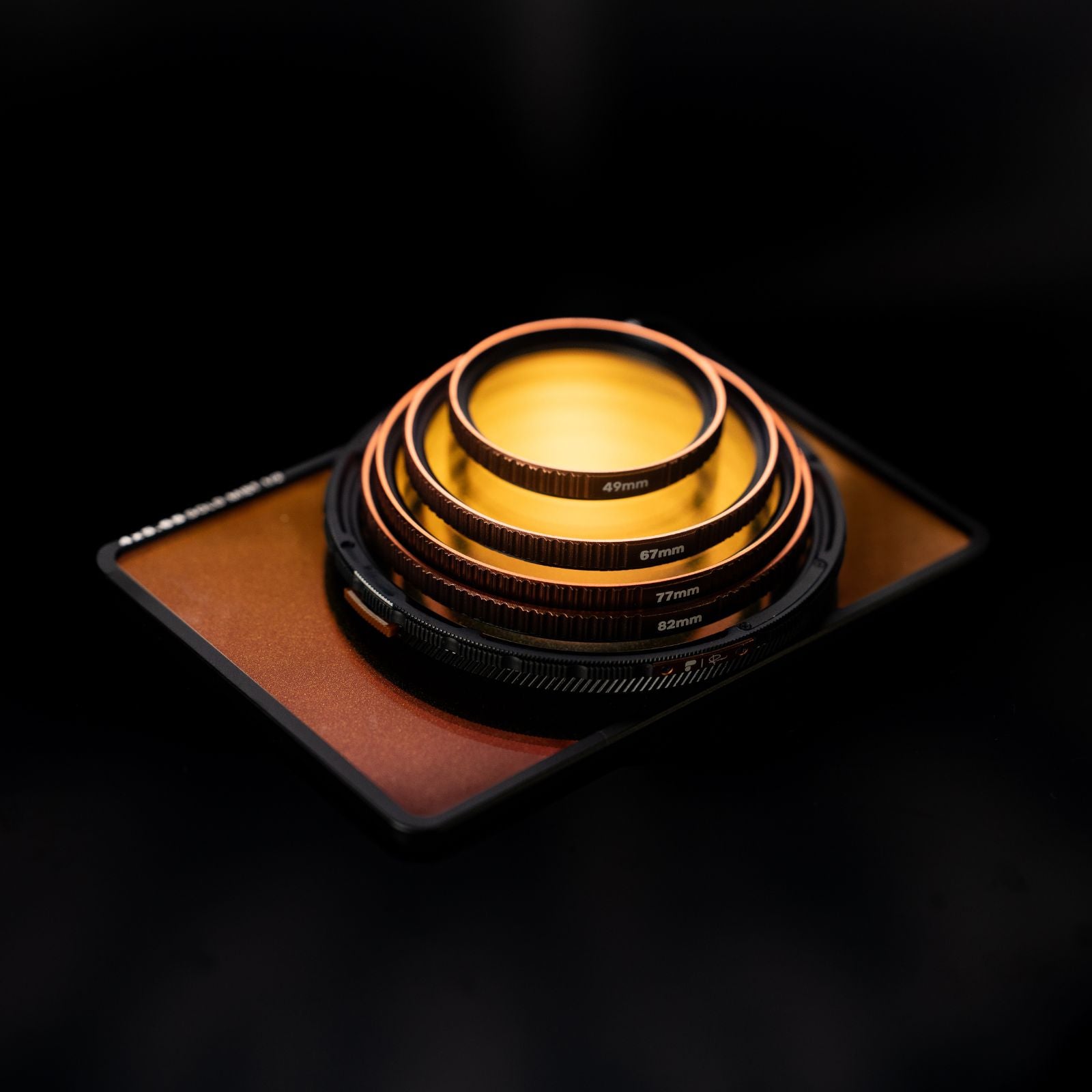
If you cannot attach it directly, you can use a " step-up ring/step-down ring " to match the filter diameter, allowing you to attach your preferred filter to your preferred lens.
In addition, step-up rings, etc. If the distance between the lens and the filter is too large, it can have disadvantages such as increased risk of vignetting, so if there is a large difference in size, we recommend purchasing a new filter that fits the size rather than trying to convert it.

Recently, there are many filters that can be attached and detached with a single touch using magnets , rather than the typical screw-on type.
These magnetic filters generally have their own proprietary standards, so a special adapter must be attached between the lens and the filter.
In addition to size and density, choosing a high-quality filter with excellent light transmittance and color reproduction will enable you to take photos without compromising image quality.